
Small but significant labour reform laws are expected to be introduced in 2008, to benefit both the employees and employers.

A section of industry may need to begin compliance immediately, even as most states are yet to notify their rules.
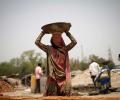
In a historic decision, the government on Friday announced the implementation of the four Labour Codes, which rationalised 29 existing labour laws, with immediate effect. The four labour codes are -- the Code on Wages, 2019, the Industrial Relations Code, 2020, the Code on Social Security, 2020 and the Occupational Safety, Health and Working Conditions Code, 2020.
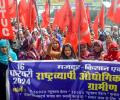
Over 25 crore workers across India are set to strike against new labour codes and privatisation, potentially disrupting banking, postal, and other essential services.

Paving the way for the first set of labour reforms in the country, President Pranab Mukherjee has given his assent to Rajasthan's amendments to three laws.

Andy Burnham has officially taken office as the new UK Prime Minister, pledging to make politics more about problem-solving and usher in a 'circuit breaker' moment for the country with significant political and economic changes.
Union Labour Minister Oscar Fernandes promised on Thursday to have a 'proper dialogue' with all on labour reforms.

Micro, small and medium enterprises (MSMEs) have expressed significant concerns regarding the labour ministry's recent clarifications on labour codes, citing ambiguity in wage calculation and implementation, which they argue creates interpretational and operational challenges for employers.

As the Centre faces multiple hurdles, BJP-governed states such as Rajasthan, Madhya Pradesh and Gujarat have swiftly moved in to usher in radical reforms as they aim to take a larger share of the FDI pie.

'With this amendment, permanent employees will cease to exist.' 'The government should give a human touch and human face to labour reforms.' 'Ideas like survival of the fittest, might is right, etc, are rules of the jungle.' 'They cannot give new terms like hire and fire to jungle law.'

Following Education Minister Dharmendra Pradhan's resignation amidst widespread student protests over the NEET paper leak, Congress leader Rahul Gandhi congratulated the youth, calling it a crucial step for education reform, and urged broader public action to hold the government accountable, demanding an apology from Prime Minister Narendra Modi.

'Why not aspire for 8 or 9 or even 10 per cent?'
Seeking a political consensus on labour reforms, Deputy Prime Minister L K Advani said on Tuesday that education, health and national security would have to be given enhanced priority to meet growing economic challenges.\n\n\n\n

Keir Starmer has come under mounting pressure to resign as the leader of the Labour Party to pave the way for Andy Burnham to take over as the new British Prime Minister.

A referendum 10 years ago on this day set the United Kingdom on a new path as a non-member of the European Union (EU) and the turmoil of that Brexit vote continues to play out as the country prepares for its seventh prime minister in a decade.

Brokerage Bernstein has warned Prime Minister Narendra Modi that India risks squandering recent economic gains unless it accelerates structural reforms, particularly in jobs, manufacturing and innovation.

India too can rise to the top if the 1.4 billion Indians back home are given better opportunities to use their innate talent and capacity to work hard, with right incentives in a more meritocratic rules-based system, asserts Ajay Chhibber.

Small Factories Act, Industrial Relations Code likely to be redrafted under pressure from Bharatiya Mazdoor Sangh
British Prime Minister and Labour Party leader Keir Starmer has announced his resignation, stating he will remain in post until a successor is elected by mid-July. The decision follows questions from his parliamentary party regarding his leadership for the next general election, with Andy Burnham widely tipped as a potential successor.

'The main problem the country faces is not low GDP growth, but low employment growth.'

As per the recommendations of the 2nd National Commission on Labour, the ministry is codifying existing 44 central labour laws into four codes by simplifying, amalgamating and rationalising the relevant provisions of the legislations.

A collaborative approach can yield better results in reforming labour laws that can be implemented in the whole country, instead of different states following different norms in their own jurisdictions. That approach could also help the governments convince the trade unions to see merit in these reforms, says A K Bhattacharya.
Leading economic think-tank NCAER has advocated slew of policy reforms, including a felxible labour regime, to boost exports from the country.
Lashing out at the opponents of labour reforms, particularly the Congress, the government on Tuesday sought political consensus on the vital issue to enable Indian industry become competitive worldwide and augment its position in the global
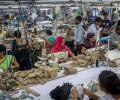
While the move may give a competitive edge over rivals like Bangladesh in the global market, several industry bodies raised concerns that many state governments may not implement it on the ground.

India's finance ministry anticipates inflation will remain relatively contained in the coming months, supported by a correction in crude oil prices and softening input costs following the cessation of the West Asia conflict, despite earlier spikes in wholesale and retail inflation.

Various reforms, including GST, labour codes, and quality control order, have been rolled out since August 15.

We have built an economy that can deliver everything -- from iPhones to biryani -- to a doorstep in 10 minutes, but it cannot deliver a fire engine through a lane in 20, points out Amit Kapoor.
After assuming power in 2014 with a full majority of its own, the BJP-led NDA government started an ambitious process of reforming labour laws in the form of codes aimed at making the framework less cumbersome with a variety of alterations. It had planned four codes each for industrial relations, wages, social security and welfare, and occupational safety, health and working conditions. To this end, 35 central labour laws were to be converted into four codes that would have had the virtue of streamlining labour relations. But none of the proposed code Bills could be converted into a law principally because neither trade unions nor industry representatives came on board. They hold the key to India's low-growth-high unemployment paradigm but the government may struggle to push them through this time as well. Somesh Jha explains why

Commerce and Industry Minister Piyush Goyal announced that India expects to operationalise nine free trade agreements (FTAs) within the next 10 months, with plans for an additional three to four significant pacts over the coming year, reinforcing India's ambition to become a global manufacturing and investment hub.

Notwithstanding the economic complementarities and the host of agreements for deepening economic relation on a host of areas, both sides share common viewpoints on the foreign policy domain and seek common grounds to serve as a counterweight to China, notes Dr Rajaram Panda.
The Group of Ministers on labour reforms, headed by Deputy Chairman of Planning Commission K C Pant, will meet on Wednesday to consider issues relating to enactment of a legislation on contract labour.\n\n\n\n

Ten days after the expansion of the BJP government's cabinet in West Bengal, key portfolios have been allocated, with senior leader Tapas Roy taking charge of industries and journalist-turned-politician Swapan Dasgupta appointed finance minister.

Male central government employees are entitled to 15 days under service rules and provisions in the private sector depends on the company's policy.
The Vasundhara Raje government's initiatives mark a critical step forward in labour law reforms.

With the Congress already opposed to the proposed law, regional parties might become the swing factor, says T N Ninan.
